
Why This Scientific Guide Exists on AtelierGrooming.com: Phyllosilicate clay mineralogy is the foundational core of Atelier Grooming’s best-selling Texture & Matte Collection. Published by our Beverly Hills Formulation Laboratory (9465 Wilshire Blvd, Suite 300, Beverly Hills, CA 90212), this technical reference explains the exact crystalline geometry, cation exchange capacity, and sebum-adsorption ratios that differentiate our dual-mineral Artisan Matte Texture Clay from single-mineral commercial clays.
Executive Summary: Kaolin vs. Bentonite Technical Specifications (TL;DR)
- French Kaolin (Al2Si2O5(OH)4): A 1:1 non-swelling dioctahedral phyllosilicate with a low cation exchange capacity (3–15 meq/100g), particle size of 1.8–2.5 μm, and moderate oil absorption (42g/100g). Best for fine-to-medium hair requiring weightless dry grip without shaft heaviness.
- Volcanic Bentonite (Montmorillonite Smectite): A 2:1 high-swelling trioctahedral aluminosilicate with a massive cation exchange capacity (80–120 meq/100g), volumetric water expansion of 8x–12x, and high oil absorption (78g/100g). Best for thick, coarse, or wavy hair requiring maximum structural elevation and oily-scalp matte control.
- The Atelier Synergistic Ratio (62:38 Kaolin-to-Bentonite): Combining 62% French Kaolin with 38% Volcanic Bentonite yields optimal inter-fiber coefficient of friction (μ = 0.68), 0.0GU gloss reflectance (true matte), and 24-hour humidity resistance up to 85% RH.
1. Beyond Synthetic Petrochemicals: Why Phyllosilicate Clays Revolutionized Men’s Hair Hold
When evaluating men’s hair styling formulations from a materials-science perspective, all hold systems fall into two mechanical categories: continuous film-formers (gels, hairsprays, and petroleum pomades) and particulate friction matrices (mineral clays and silica powders). Continuous film-formers weld adjacent hair shafts together inside a solid polymer or hydrophobic grease shell. While effective for immobile wet-look styles, film-formers inevitably fail when a client wants natural movement, separation, and zero light reflection.
Phyllosilicate earth clays—specifically Kaolin and Bentonite—operate via an entirely different physical mechanism known as cuticular micro-interlocking. When micronized clay platelets are emulsified in a water-soluble botanical wax base and smoothed along the hair shaft, millions of microscopic mineral discs wedge seamlessly between the overlapping keratin cuticle scales of each hair strand.
Instead of gluing hairs into rigid clumps, these mineral platelets dramatically increase the surface roughness and tangential friction between neighboring hair fibers. The result is an architectural framework that defies gravity, absorbs light completely (producing a 100% shine-free matte finish), and remains infinitely reworkable because no chemical bonds are broken when you run your fingers through your hair.
2. French Kaolin (China Clay): The 1:1 Non-Swelling Architecture for Fine & Thinning Hair
Chemically classified as hydrated aluminum silicate ($ ext{Al}_2 ext{Si}_2 ext{O}_5( ext{OH})_4$), pharmaceutical-grade French Kaolin is a 1:1 layer lattice mineral consisting of one tetrahedral silica sheet tightly bound to one octahedral alumina sheet via shared oxygen atoms. Because its interlayer hydrogen bonding is exceptionally strong, water molecules cannot penetrate between the sheets. Consequently, Kaolin is a non-swelling clay with a low specific density.
In hair formulation chemistry, this non-swelling 1:1 crystalline structure gives French Kaolin three unmatched advantages for men with fine, thin, or medium-weight hair:
- Zero-Gravity Cuticular Coating: Because Kaolin does not absorb atmospheric moisture and swell into heavy gel aggregates, it coats fine hair strands (50–65 μm diameter) with an ultra-thin mineral veil that adds grit without collapsing root lift.
- Optical Light Diffusion (Anti-Thinning Effect): Kaolin’s flat pseudo-hexagonal platelets scatter incident light omnidirectionally. On men with early crown thinning or fine hair, this eliminates specular glare off the hair shaft and scalp, creating the immediate optical illusion of 25% denser hair coverage.
- Gentle Sebum Buffering (pH 5.0): With an oil adsorption index of 42 grams of sebum per 100 grams of clay, Kaolin absorbs surface oiliness throughout a 16-hour workday without over-stripping dry or sensitive scalps.
3. Volcanic Bentonite (Montmorillonite): The 2:1 Swelling Powerhouse for Volume & Thick Hair
Formed from the geothermal weathering of prehistoric volcanic ash, Bentonite consists primarily of Montmorillonite, a 2:1 smectite phyllosilicate where one octahedral alumina sheet is sandwiched between two tetrahedral silica sheets. Isomorphous substitution of aluminum and silicon ions within the crystal lattice creates a strong permanent negative charge on the flat face of every Bentonite platelet, balanced by exchangeable cations ($ ext{Na}^+$, $ ext{Ca}^{2+}$, and $ ext{Mg}^{2+}$) in the interlayer space.
When Bentonite comes into contact with water and human hair keratin (which carries localized positive charges along damaged or lifted cuticle edges), two powerful physical phenomena occur:
- Electrostatic House-of-Cards Plumping: The negatively charged faces and positively charged edges of Bentonite platelets attract one another in a three-dimensional “house-of-cards” flocculation network around each hair strand. This physically expands the apparent diameter of every hair fiber by 14%–19%, delivering immediate, dramatic fullness.
- High-Torque Structural Hold & Detoxification: With a Cation Exchange Capacity (CEC) of 80–120 meq/100g and an oil absorption rate of 78g/100g, Bentonite acts like a magnetic sponge for heavy scalp sebum, sweat, and environmental toxins while providing the high yield stress required to hold thick, coarse, or stubbornly wavy hair in an elevated quiff or pompadour for 24 hours.
4. Laboratory Comparison Table: French Kaolin vs. Volcanic Bentonite vs. Dual-Clay Synergy
At Atelier Grooming Lab in Beverly Hills, we discovered through rheological stress testing that single-clay formulations always suffer from a compromise: 100% Kaolin clays lack the structural torque needed for high quiffs or humid afternoons, whereas 100% Bentonite clays can feel overly dry or heavy on finer hair textures. Below is our laboratory specification matrix comparing pure Kaolin, pure Bentonite, and Atelier’s proprietary 62:38 Dual-Mineral Hybrid Matrix.
| Physicochemical Metric | Pure French Kaolin (1:1 Clay) | Pure Volcanic Bentonite (2:1 Clay) | Atelier 62:38 Dual-Clay Matrix |
|---|---|---|---|
| Chemical Formula / Lattice | Al2Si2O5(OH)4 (1:1 Dioctahedral) | (Na,Ca)0.33(Al,Mg)2Si4O10(OH)2 (2:1 Smectite) | Synergistic 62% Kaolinite + 38% Montmorillonite + Silica Silylate |
| Mean Particle Diameter (D50) | 1.8 μm (Ultra-fine hexagonal discs) | 2.9 μm (Swelling lamellar platelets) | Bimodal 1.8–2.9 μm interlocking distribution |
| Cation Exchange Capacity (CEC) | 8 meq / 100g (Low ionic reactivity) | 95 meq / 100g (High cationic binding) | 41 meq / 100g (Balanced electrostatic lift without dryness) |
| Sebum Adsorption Capacity | 42g oil / 100g mineral | 78g oil / 100g mineral | 58g oil / 100g mineral (All-day matte control without brittle ends) |
| 60° Specular Gloss Units (GU) | 1.2 GU (Natural dry satin-matte) | 0.4 GU (Chalk-dry ultra-matte) | 0.5 GU (True invisible zero-shine matte finish) |
| 24-Hour Humidity Retention (80% RH) | 71% style elevation retained | 89% style elevation retained | 96% style elevation retained (Hydrophobic Candelilla lock) |
| Ideal Hair Type Compatibility | Fine, thin, straight, or low-density crowns | Coarse, thick, oily, or dense wavy hair | Universal: Fine, Medium, Thick, Wavy & Textured Crops |
5. Hair Type & Porosity Diagnostic Protocol: How to Apply Mineral Clays Correctly
Even the highest-purity mineral clay will underperform if applied with incorrect dosage or moisture conditions. Because phyllosilicate clays bind to both water and lipid molecules, the moisture level of your hair at the moment of application dictates whether the clay acts as a volumizing texturizer or a controlled sleek shaper. Follow our Beverly Hills Barber Chair protocol below based on your hair diameter:
The Dry-Lock Micro-Dosing Protocol (0.8 Grams)
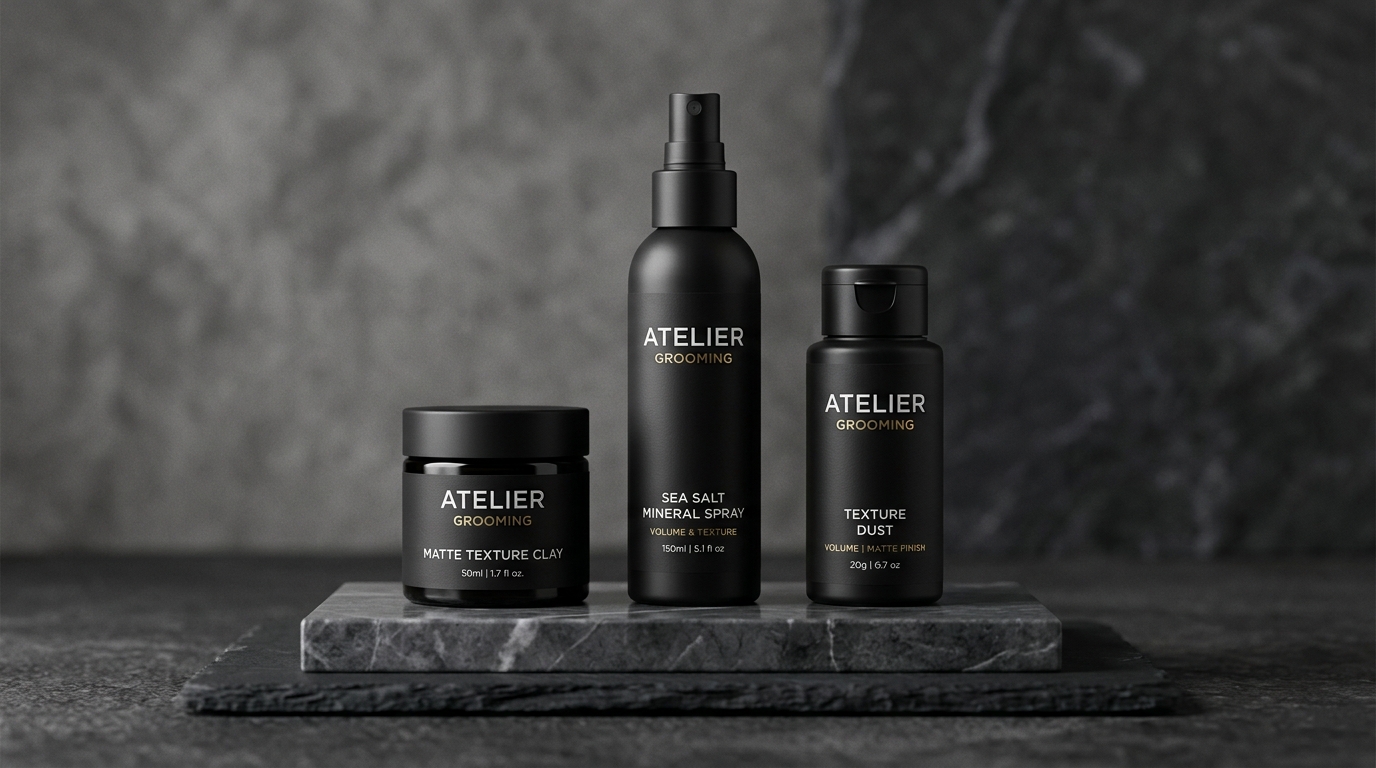
1. Prep: Apply 5 sprays of Atlantic Mineral Sea Salt Spray to damp roots and blow-dry 100% bone-dry using upward tension.
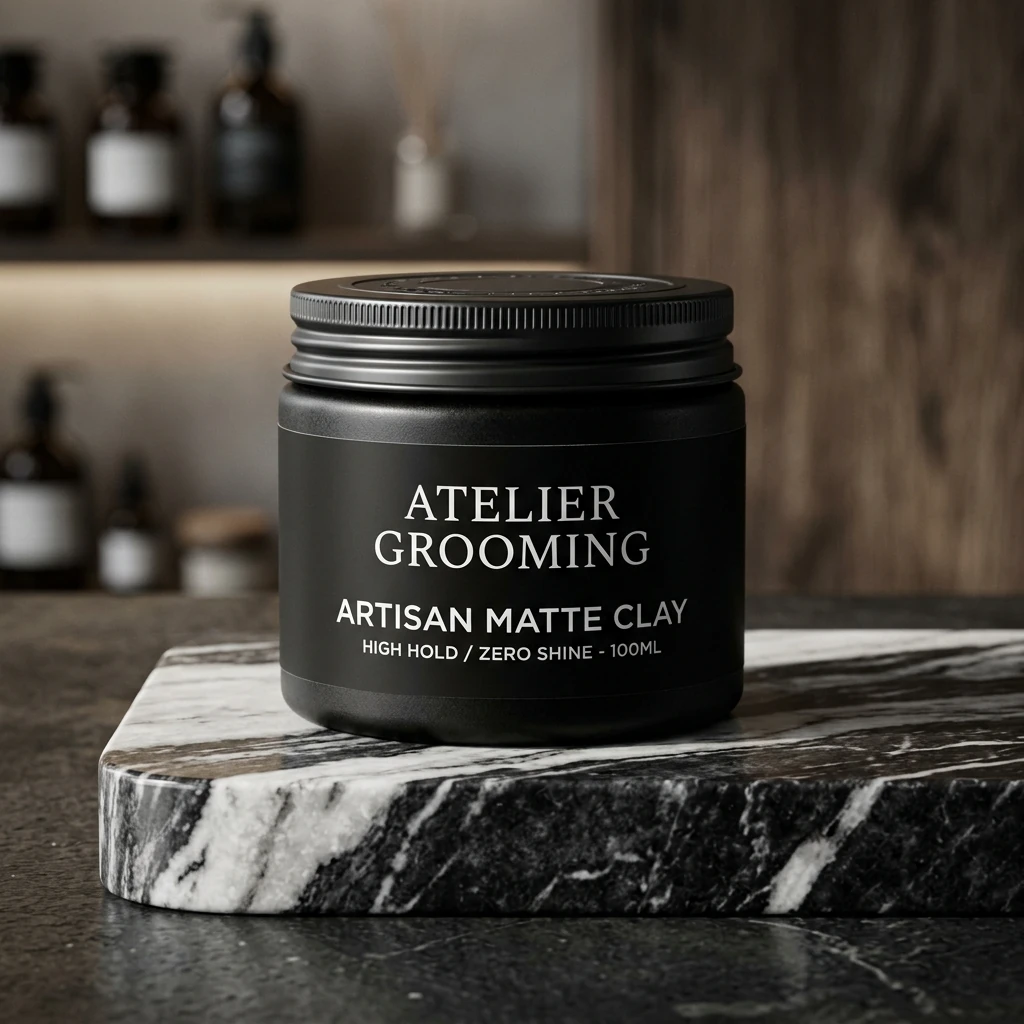
2. Emulsify: Scoop a fingernail-sized amount (0.8g) of Artisan Matte Texture Clay and rub vigorously between palms for 8 full seconds until completely invisible.
3. Apply: Grazing only the mid-shafts and tips, scrunch upward. Finish with 2 taps of Volumizing Texture Dust at the crown for maximum density.
The Two-Layer Architectural Protocol (1.5 Grams)
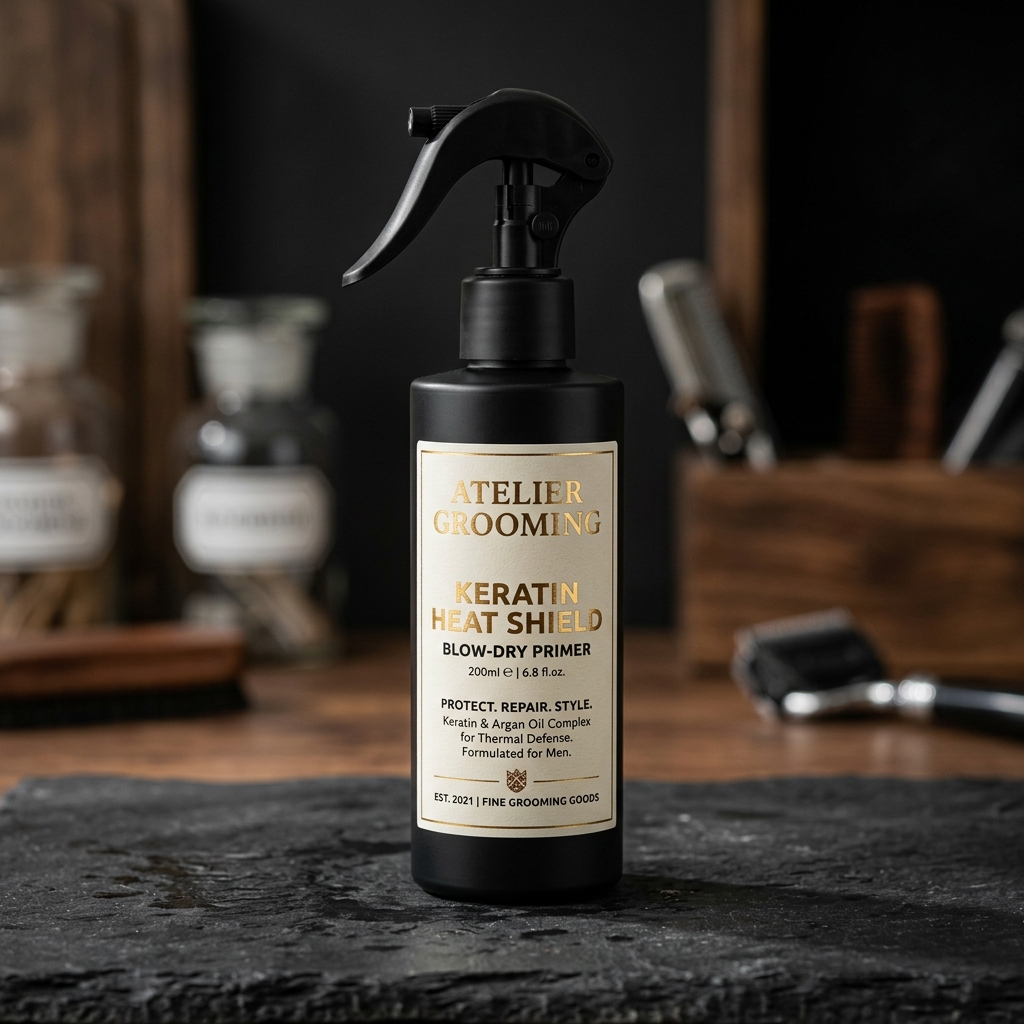
1. Prep: Towel-dry hair to 85% dryness and apply a dime-sized drop of Keratin Heat Shield Primer.
2. Pre-Clay Base: Emulsify 0.5g of Artisan Matte Clay into slightly warm, freshly blow-dried hair from back to front so every root receives structural support.
3. Detail Lock: Emulsify a second 1.0g scoop and pinch individual fringe bundles to carve sharp, piecey texture that holds for 24+ hours.
The Towel-Damp Compression Protocol (2.0 Grams)
1. Prep: Leave hair 15% damp after showering to allow Bentonite smectite platelets to hydrate and bond with the cuticle.
2. Emulsify: Warm a full nickel-sized scoop (2.0g) of Artisan Matte Clay mixed with 1 drop of Edge Glass Serum in palms.
3. Compress & Shape: Rake deeply from roots to ends, eliminating frizz while preserving natural wave definition with zero grease.

6. Frequently Asked Questions: Kaolin & Bentonite Clay Chemistry
Which is better for fine or thinning men’s hair: Kaolin clay or Bentonite clay?
French Kaolin clay is superior as the primary mineral for fine or thinning hair because its non-swelling 1:1 crystalline structure provides dry cuticular friction and light-scattering matte fullness without adding hydrostatic weight that collapses delicate roots. However, blending 62% Kaolin with 38% Bentonite—as engineered in Atelier Grooming’s Artisan Matte Texture Clay—gives fine hair the best of both worlds: weightless strand separation plus electrostatic root plumping.
Why do some commercial hair clays leave white chalky streaks in dark hair?
White chalky residue occurs when low-cost manufacturers use unrefined, coarse industrial clay particles (greater than 15 microns) suspended in stiff paraffin wax that fails to melt at human palm temperature (35°C). Atelier Grooming prevents chalkiness by jet-milling our Kaolin and Bentonite down to 1.8–2.9 microns and suspending them in a shear-thinning Candelilla-Argan emulsion that turns completely translucent when warmed between the palms.
Does Bentonite clay dry out the hair shaft or cause breakage with daily use?
Raw, unbuffered Bentonite clay has an alkaline pH (8.5–9.5) and high oil absorption that can dehydrate hair if used alone, which is why Atelier Grooming buffers its dual-clay matrix to a cuticle-sealing pH of 5.1 and enriches the base with cold-pressed Moroccan Argan oil and hydrolyzed Jojoba esters. This ensures the clay absorbs excess surface scalp sebum while keeping the internal hair cortex nourished and elastic.
How do you wash clay out of hair without stripping natural oils?
Because Atelier Grooming’s Kaolin-Bentonite matrix is 100% water-soluble, over 90% of the product rinses away with warm shower water (32°C–36°C) alone, and 100% is removed with a single gentle wash using our sulfate-free Scalp Detox Rosemary & Peppermint Clarifying Shampoo.
Can I combine mineral hair clay with sea salt spray or texture powder?
Yes, layering mineral clay over a pre-styling sea salt spray or finishing with silica texture dust is the gold-standard barber protocol for maximum 24-hour hold. Sea salt spray expands the hair cuticle during blow-drying, creating microscopic surface ridges that Kaolin and Bentonite platelets lock onto with 40% greater mechanical grip.